Numbers can be loud, but they don’t always tell the full story. On LinkedIn, many professionals chase bigger audiences, hoping that more followers will automatically mean stronger influence. Yet, what truly defines impact is not just how many people see your profile, but how many actually interact with your ideas.
A small but active audience that comments, reacts, and shares can often create more opportunities than thousands of silent followers. This is why the debate around LinkedIn Followers vs. Engagement matters so much. It’s about shifting focus from vanity metrics to meaningful connections. When you understand the difference, you’ll see that engagement is the real signal of relevance, trust, and authority in your professional space.
Key Factors to Consider
LinkedIn Followers Versus Engagement: What You Need to Know

Understanding the difference between followers and engagement is key to making your LinkedIn presence truly effective. Followers are the people who see your content, but engagement is what shows if your content actually connects with them. It’s easy to get caught up in the number of followers because it feels like a clear sign of success. But without engagement, those numbers don’t mean much. Engagement means likes, comments, shares, and conversations happening around your posts. It’s the proof that your content matters to your audience.
Followers give you reach, but engagement gives you influence. When people interact with your posts, they’re not just passively scrolling; they’re actively involved. This involvement builds trust and opens doors to new opportunities. It’s the difference between being seen and being remembered.
Engagement also helps you understand what your audience cares about. When you see which posts get the most reactions or comments, you learn what topics hit home. This insight lets you create content that feels personal and relevant, which encourages even more interaction. It’s a cycle that grows your presence naturally and meaningfully.
While followers are important for visibility, engagement is the heartbeat of your LinkedIn success. It’s what turns numbers into relationships and connections into opportunities. Keep your eyes on engagement, and you’ll build a LinkedIn presence that truly works for you.
Understand the Differences Between LinkedIn Followers And Engagement
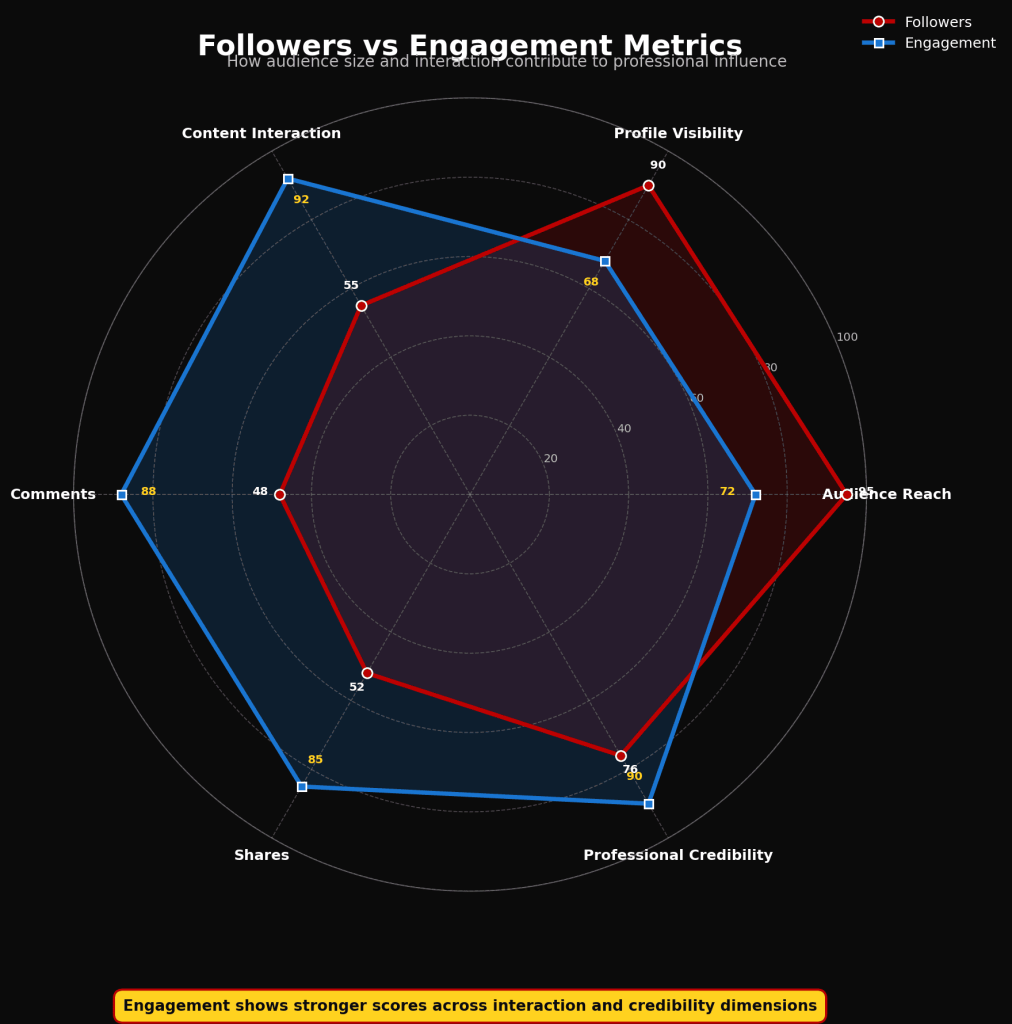
Followers represent visibility, while engagement reflects interaction. Having many followers may increase reach, but without engagement, the audience remains passive. Engagement shows that your content resonates and sparks conversation.
Followers are the crowd that notices you, but engagement is the applause that tells you they care. When people engage, they’re not just seeing your posts, they’re reacting, sharing their thoughts, and joining the conversation. This active participation is what builds real connections and trust.
Without engagement, your message can get lost in the noise. It’s like speaking to a room full of people who don’t respond. Engagement turns that silence into a dialogue, making your content more memorable and impactful.
On the other hand, engagement helps you learn what your audience truly values. When certain posts get more likes or comments, it’s a clear sign of what resonates. This feedback loop lets you tailor your content to keep your audience interested and involved.
Understand Why Audience Quality Matters
Quality followers are those who consistently interact with your posts. They amplify your reach by commenting, sharing, and reacting. A smaller but active audience often drives more meaningful outcomes than a large, disengaged one.
It’s not about stacking numbers like trophies. It’s about having people who actually care about what you say and show up for it. These are the folks who don’t just scroll past, they stop, think, and jump into the conversation. That kind of energy is priceless.
Here’s why focusing on quality followers makes all the difference:
- Active followers boost your visibility more than silent ones. When they comment or share, your content reaches beyond your immediate circle, pulling in fresh eyes and new connections.
- Engaged followers build trust. When people see real conversations happening, they’re more likely to believe you’re the real deal, not just noise in the feed.
- They give you honest feedback. These followers aren’t afraid to tell you what works and what doesn’t, helping you sharpen your message and grow.
- Quality followers create opportunities. Whether it’s collaborations, job offers, or partnerships, engaged audiences open doors that numbers alone can’t.
- They keep your motivation alive. Seeing real people respond to your work keeps the fire burning, even when the algorithm feels like it’s against you.
A smaller, engaged crowd beats a massive, quiet one any day. It’s about building a community that gets you and pushes you forward. That’s where the real value lies.
Does Follower Count Drive Engagement?

This question gets to the heart of what many LinkedIn users obsess over. It’s tempting to think that a big follower count means your posts will light up with activity. But here’s the truth: having a large number of followers doesn’t guarantee they’ll engage. In fact, many profiles with thousands of followers see very little interaction.
Why? Because not all followers are created equal, and not all are ready to jump into the conversation.
Here’s what you need to know about why follower count alone can’t carry the weight of engagement:
- Followers can be passive observers. Many people follow accounts just to keep an eye on updates without reacting or commenting. They’re there, but they’re quiet.
- Interest levels vary widely. Some followers might have clicked “follow” on a whim or during a networking spree but don’t really care about the content you share.
- Content relevance matters. Even with a big audience, if your posts don’t hit the mark, engagement will stay low. It’s about what you say, not just who sees it.
- Algorithms favor engagement, not numbers. LinkedIn’s feed pushes content that sparks reactions and conversations, so a smaller, engaged audience can get more visibility than a large, silent one.
- Building relationships takes time. Engagement grows when you nurture your audience, respond to comments, and create a community, not just chase numbers.
In a nutshell, while follower count gives you a stage, it’s the engagement that brings your performance to life. Focus on creating content that invites interaction, and watch your LinkedIn presence thrive.
1. Identify Why Large Audiences Stay Quiet
Large audiences often remain silent because not all followers are genuinely interested. Some follow for networking or curiosity, but only a fraction actively engages. This highlights the importance of focusing on relevance over sheer numbers.
Having a huge follower count can feel like a win, but if most of those followers are just “lurkers,” your content might as well be shouting into the void. Engagement doesn’t just happen because of numbers; it’s about who is actually paying attention and why.
Not every follower is itching to comment or share. Many are passive, scrolling through their feeds without a second thought. That’s why focusing on relevance is key: your content needs to speak to the right people, not just anyone who clicks “follow.”
Your audience is like a party. You want guests who dance, laugh, and chat, not just wallflowers standing in the corner. The same goes for LinkedIn followers.
Here’s what keeps large audiences quiet:
- Followers might not find your content relatable. If your posts don’t hit their interests or needs, they’ll scroll past without a peep.
- Some follow out of obligation or habit. Networking events, connections, or just a random click can add followers who aren’t truly invested.
- Content overload causes fatigue. With so much noise on LinkedIn, even interested followers can get overwhelmed and tune out.
- Lack of personal connection. People engage more when they feel a genuine link to the person behind the posts.
- Timing and visibility issues. Sometimes your posts just don’t show up when followers are active, killing chances for interaction.
Understanding these reasons helps you focus on crafting content that actually wakes your audience up and gets them talking. It’s not about shouting louder; it’s about saying the right things to the right people at the right time.
2. Compare LinkedIn Follower Quality With Quantity
Quantity can provide visibility, but quality ensures impact. A thousand followers who never interact add little value compared to a hundred who consistently engage. Quality followers build trust and credibility in your professional space.
It’s not just about numbers on a screen; it’s about the real connections that make your LinkedIn presence worth something.
Here’s what makes quality followers stand out:
- Your followers are genuinely interested. These followers don’t just hit “follow” and disappear. They care about your content and show it through likes, comments, and shares that spark conversations.
- Your message gets amplified. When quality followers engage, their networks catch your content too. This ripple effect pulls in fresh eyes and new chances.
- Honest feedback flows in. Engaged followers offer real opinions and constructive criticism that help you sharpen your message and grow your influence.
- Your reputation shines brighter. Active followers who interact regularly prove to others that you’re credible and worth paying attention to.
- Motivation stays alive. Seeing real people respond to your work fuels your passion and keeps you posting, even when the algorithm feels like it’s working against you.
- Connections turn into opportunities. These followers often open doors for collaborations, partnerships, or new projects that numbers alone can’t unlock.
How to Measure LinkedIn Engagement Effectively

Understanding how engaged your LinkedIn audience is can feel like trying to catch smoke with your bare hands. But it doesn’t have to be that tricky. When you get a clear picture of how people interact with your posts, you unlock the real power behind your presence. This isn’t just about numbers on a screen, it’s about knowing what clicks, what sparks conversations, and what keeps your community coming back for more.
This part works as your backstage pass to the real LinkedIn show. You’ll find out how to track the right signals, understand what they mean, and use that knowledge to keep your audience hooked. It’s about turning data into dialogue and numbers into relationships.
Once you grasp these ideas, the steps that follow will make perfect sense, and you’ll be ready to take control of your LinkedIn engagement like a pro.
1. Calculate Your LinkedIn Engagement Rate
Understanding your LinkedIn engagement rate is like having a secret map to what really clicks with your audience. It’s not just a number; it’s a pulse check on how your content is landing and whether people are actually paying attention. This rate shows you the real action behind the scenes: the likes, comments, and shares that turn a simple post into a conversation.
Engagement rate measures the total interactions your posts get, divided by either your follower count or the number of impressions. This gives you a clear picture of how much your audience is involved, not just how many eyes see your content.
Here are some key points that add depth to the idea:
- Engagement rate isn’t just about big numbers. A smaller, highly engaged audience can have a much stronger impact than a huge crowd that barely reacts.
- Using followers in the calculation shows how active your community is, while using impressions reveals how well your content performs in the feed.
- Tracking engagement rate over time helps you spot trends: what’s working, what’s fading, and where to focus your energy next.
- Different types of content can have wildly different engagement rates, so comparing posts helps you find your sweet spot.
- Engagement rate is your best friend when it comes to proving value: whether you’re pitching yourself, your brand, or your business.
Here’s a quick example:
If you have 1,000 followers and your post gets 50 likes, 10 comments, and 5 shares, your engagement rate using followers would be (50 + 10 + 5) ÷ 1,000 = 6.5%. That means 6.5% of your followers actively interacted with your post, which is a strong result.
If the same post had 5,000 impressions, your engagement rate using impressions would be (50 + 10 + 5) ÷ 5,000 = 1.3%. This shows how many people who saw the post actually engaged.
Knowing these numbers helps you focus on creating content that sparks real connections, not just empty views. It’s about quality, not just quantity, and this metric is your guide to making every post count.
2. Compare Engagement Across Different Posts
Not all posts perform equally. Comparing engagement across posts reveals which topics, formats, or styles resonate most with your audience really wants. This insight guides future content strategies.
Diving deeper into your post performance can feel like detective work, but it’s worth every minute. When you look closely, you start to see patterns that tell you what your audience really wants. This isn’t just about numbers; it’s about understanding the why behind those numbers.
Here’s what to keep an eye on when comparing posts:
- Topic relevance matters. Posts that touch on current trends or solve real problems tend to get more love. Your audience wants content that feels timely and useful.
- Format makes a difference. Videos, images, and polls often spark more interaction than plain text. Mixing up your formats keeps things fresh and exciting.
- Timing is everything. Posting when your audience is most active can boost engagement. It’s like catching people when they’re ready to listen.
- Tone and voice count. Posts that sound like a real person, with personality and warmth, invite more responses. People connect with authenticity.
- Call to action works. Asking questions or encouraging comments can turn a passive scroll into an active conversation.
Tracking these details helps you fine-tune your content strategy. You’ll start creating posts that don’t just get seen but get talked about, and that’s where the real value happens.
3. Understand Useful Engagement Benchmarks
Benchmarks give you a way to see how your LinkedIn engagement stacks up. They work as a reality check that helps you figure out if your content is hitting the mark or just floating in the void.
A solid engagement rate usually falls between 2% and 6%, but this can shift depending on your industry and audience size, according to industry-wide LinkedIn engagement benchmark data. Knowing where you stand helps you set realistic goals and spot when your content really connects.
Here’s why benchmarks matter and what they tell you:
- They show if your engagement is healthy or needs a boost. If you’re below the average, it’s a sign to rethink your content or approach.
- Benchmarks help you compare your performance with peers or competitors, giving you a clearer picture of your standing.
- They highlight trends over time, so you can see if your engagement is growing, steady, or slipping.
- Understanding benchmarks helps you tailor your content strategy to what works best in your niche.
- They provide proof of value when you’re pitching yourself, your brand, or your business to others.
Tracking these numbers isn’t about obsessing over every like or comment. It’s about spotting patterns and making smarter choices. When you know the benchmarks, you’re not just guessing; you’re making moves that count. That’s how you turn LinkedIn from a numbers game into a real connection.
Here’s Why Engagement Matters More Than Numbers
Follower count can help establish visibility and social proof, but meaningful engagement is generally more valuable when evaluating whether a LinkedIn audience is active and relevant. A smaller audience that consistently reads, comments, reacts, shares, or responds to content can be more useful than a large audience that rarely interacts.
When you focus on creating useful content and encouraging real conversations, you’re not just chasing followers, you’re building a community. This community becomes your strongest asset, opening doors to opportunities and collaborations.
If you want your LinkedIn presence to thrive, put engagement front and center. It’s the heartbeat of meaningful connections and the key to turning your network into a powerful resource.
Open an account with Famecheap today and watch your social media presence soar. Share your thoughts or experiences in the comments below, let’s get the conversation started!
Frequently Asked Questions
Followers represent visibility, while engagement reflects interaction. Having many followers may increase your reach, but without engagement, your audience remains passive. Think of followers as the crowd that notices you, but engagement is the applause that tells you they care. When people engage, they are not just seeing your posts. They are reacting, sharing their thoughts, and joining the conversation. This active participation is what builds real connections and trust. Without engagement, your message can get lost in the noise. It is like speaking to a room full of people who do not respond. Engagement turns that silence into a dialogue, making your content more memorable and impactful. Engagement also helps you learn what your audience truly values. When certain posts get more likes or comments, it is a clear sign of what resonates. This feedback loop lets you tailor your content to keep your audience interested and involved. So while followers give you a stage, engagement is the spotlight that highlights your presence. Focusing on engagement means focusing on relationships, not just numbers. It is the difference between being seen and being heard, between having a crowd and having a community. Understanding this difference is key to making your LinkedIn presence truly effective.
No, a large follower count does not automatically drive engagement on LinkedIn. It is tempting to think that a big follower count means your posts will light up with activity, but the truth is that having a large number of followers does not guarantee they will engage. In fact, many profiles with thousands of followers see very little interaction. Why? Because not all followers are created equal, and not all are ready to jump into the conversation. Followers can be passive observers. Many people follow accounts just to keep an eye on updates without reacting or commenting. Interest levels also vary widely. Some followers might have clicked follow on a whim or during a networking spree but do not really care about the content you share. Content relevance matters too. Even with a big audience, if your posts do not hit the mark, engagement will stay low. It is about what you say, not just who sees it. Additionally, LinkedIn algorithms favor engagement, not numbers. The feed pushes content that sparks reactions and conversations, so a smaller, engaged audience can get more visibility than a large, silent one. Building relationships takes time. Engagement grows when you nurture your audience, respond to comments, and create a community, not just chase numbers. So while follower count gives you a stage, it is engagement that brings your performance to life.
Large LinkedIn audiences often remain silent because not all followers are genuinely interested. Some follow for networking or curiosity, but only a fraction actively engages. This highlights the importance of relevance over sheer numbers. Having a huge follower count can feel like a win, but if most of those followers are just lurkers, your content might as well be shouting into the void. Engagement does not just happen because of numbers. It is about who is actually paying attention and why. Not every follower is itching to comment or share. Many are passive, scrolling through their feeds without a second thought. That is why focusing on relevance is key. Your content needs to speak to the right people, not just anyone who clicks follow. There are several reasons large audiences stay quiet. Followers might not find your content relatable. If your posts do not hit their interests or needs, they will scroll past without a peep. Some follow out of obligation or habit. Networking events, connections, or just a random click can add followers who are not truly invested. Content overload causes fatigue. With so much noise on LinkedIn, even interested followers can get overwhelmed and tune out. Lack of personal connection also plays a role. People engage more when they feel a genuine link to the person behind the posts. Timing and visibility issues can also kill chances for interaction. Understanding these reasons helps you focus on crafting content that actually wakes your audience up and gets them talking.
Calculating your LinkedIn engagement rate is like having a secret map to what really clicks with your audience. It is not just a number. It is a pulse check on how your content is landing and whether people are actually paying attention. This rate shows you the real action behind the scenes, including the likes, comments, and shares that turn a simple post into a conversation. Engagement rate measures the total interactions your posts get, divided by either your follower count or the number of impressions. This gives you a clear picture of how much your audience is involved, not just how many eyes see your content. Here is a quick example. If you have 1,000 followers and your post gets 50 likes, 10 comments, and 5 shares, your engagement rate using followers would be (50 + 10 + 5) divided by 1,000, which equals 6.5%. That means 6.5% of your followers actively interacted with your post. If the same post had 5,000 impressions, your engagement rate using impressions would be (50 + 10 + 5) divided by 5,000, which equals 1.3%. This shows how many people who saw the post actually engaged. Knowing these numbers helps you focus on creating content that sparks real connections, not just empty views. It is about quality, not just quantity, and this metric is your guide to making every post count.
Engagement matters more than follower numbers because it is the real signal of relevance, trust, and authority in your professional space. Follower count can help establish visibility and social proof, but meaningful engagement is generally more valuable when evaluating whether a LinkedIn audience is active and relevant. A smaller audience that consistently reads, comments, reacts, shares, or responds to content can be more useful than a large audience that rarely interacts. Quality followers are those who consistently interact with your posts. They amplify your reach by commenting, sharing, and reacting. A smaller but active audience often drives more meaningful outcomes than a large, disengaged one. It is not about stacking numbers like trophies. It is about having people who actually care about what you say and show up for it. These are the folks who do not just scroll past. They stop, think, and jump into the conversation. Active followers boost your visibility more than silent ones. When they comment or share, your content reaches beyond your immediate circle, pulling in fresh eyes and new connections. Engaged followers build trust. When people see real conversations happening, they are more likely to believe you are the real deal. Quality followers create opportunities. Whether it is collaborations, job offers, or partnerships, engaged audiences open doors that numbers alone cannot. When you focus on creating useful content and encouraging real conversations, you are not just chasing followers. You are building a community that becomes your strongest asset.